Are Casual Multiplayer Games Fair? A Practical Guide

Last Updated: November 5, 2026
Quick Summary
Casual multiplayer games are fair when the outcome is decided by skill and decisions, both players see the same information, and neither side starts with an unearned advantage. Fairness splits into skill, information, and technical dimensions, and most claims that games are rigged trace back to games that trust the player's device instead of verifying moves on the server.
- A fair match is decided by skill and decisions, with equal information and no unearned advantage.
- Matchmaking trades off skill closeness, connection quality, queue time, and party size and composition.
- Thin player pools, smurfs, and rating drift break matchmaking without any conspiracy involved.
- Server-side move verification means the server, not the player's device, decides whether a move is legal.
- Score matchmaking, rules, content access, input methods, and team balance separately rather than as one number.
Table of Contents
- What Fairness Actually Means in Casual Multiplayer
- Multiplayer Matchmaking Fairness: How Games Pair Unequal Players
- Casual vs Competitive Gaming: Where the Pressure Comes From
- The Skill Gap Problem: New Players vs Experienced Players
- Server-Side Move Verification and Other Anti-Cheat Basics
- How to Play Games With Friends Remotely Without the Unfairness
- A Step-by-Step Way to Evaluate a Game's Fairness
- Challenge a Friend to a Fair Match
- Frequently Asked Questions
What Fairness Actually Means in Casual Multiplayer
Fairness in casual multiplayer games means both players have a real chance to win based on their own decisions, not hidden advantages, connection speed, or spending. This question sits at the center of many casual two-player games.
Here is the practical definition we use: a fair match is one where the outcome is decided by skill and decisions, both players can see the same information, and neither side starts with an advantage they did not earn.
Three Dimensions of a Fair Match
Fairness splits into three separate questions. A game can pass one and fail another.
- Skill fairness: Are the players close enough in ability that the better player usually wins, but not so far apart that the result is decided before the first move?
- Information fairness: Can both players see the same board, timer, and rules? Hidden information is fine if it is part of the design. Hidden advantages are not.
- Technical fairness: Does the game verify moves on the server, or trust whatever the player's device claims happened?
Most arguments about casual games being "rigged" come down to dimension three. Players blame matchmaking when the real problem is that the game lets one side's phone decide what counts as a valid move.
Nielsen's research on game usability and player trust makes a related point: players judge a system's fairness by what they can see, not by what is actually happening underneath.
Multiplayer Matchmaking Fairness: How Games Pair Unequal Players
Multiplayer matchmaking fairness is the practice of pairing players of similar skill so that neither side has a built-in edge. Good matchmaking is mostly invisible.
Most ranking systems rest on a rating model. Two names come up repeatedly: Elo, developed for chess, and Glicko, which adds a confidence measure so the system knows how sure it is about a player's rating.
The Four Levers That Decide Match Quality
Matchmaking is a trade-off between four things, and every game tunes them differently:
- Skill closeness. Tighter skill matching produces better matches but longer queues. A game with a large pool can afford tight matching; a small one cannot.
- Connection quality. Ping, packet loss, and jitter decide whether a fair skill match still feels fair. A perfectly matched opponent on a bad connection is not a fair match. Games that hide ping or region make this worse, because the player blames skill when the problem is the network.
- Queue time. Every second spent searching is a second not playing. Systems widen the skill band as the queue grows, which is why the first match of the morning is often lopsided.
Players judge matchmaking by the last match they lost, not by the distribution of their last twenty. That is a perception problem as much as an algorithm problem, which is why transparent post-match information, showing both players' ratings or the skill band used, tends to reduce complaints even when the underlying matching has not changed.
Why Matchmaking Can Still Feel Rigged
Three things break matchmaking, and none of them are conspiracies.
- Thin player pools. A game with a small audience cannot always find a close match, so it widens the search and pairs you with someone far better or worse. That is a queue-time trade-off, not a plot.
- Smurfs and second accounts. Experienced players create fresh accounts to stomp new players. The system sees a beginner and matches accordingly. Games counter this with phone verification, account-level checks, or faster rating convergence for new accounts, but none of these is free.
- Rating drift. Ratings go stale. A player who took six months off comes back at a rating that no longer reflects their skill, and the first few matches are lopsided. Some systems apply a decay or provisional period after inactivity; others do not.
Watch out: a game that never shows you your rating or the skill band it used is asking you to trust an invisible referee.
Here is the part most guides skip: for a two-player casual game, the fix is often to remove matchmaking entirely. If you are playing against a friend you already chose, there is no algorithm to blame.
Casual vs Competitive Gaming: Where the Pressure Comes From
Casual vs competitive gaming is less about the game and more about what the players expect from it.
Pressure to win comes from four places:
- Visible rank. The moment a game shows you a badge, a tier, or a number, losing stops being harmless.
- Teammates. Solo losses sting less than letting down four other people.
- Time investment. If you have played for two years, a loss feels like wasted practice.
- Public stats. Anything tracked publicly becomes something to protect.
Casual play strips most of these out. No rank, no team, no season reset, no audience.
Research on competitive pressure and player motivation in games suggests that the drive to compete and the drive to relax pull in opposite directions, and players often want both from the same hobby.
If you want a closer look at how pressure and platform design interact in friend-play settings, our breakdown of casual friend-play platforms digs into the trade-offs.
The Skill Gap Problem: New Players vs Experienced Players
The skill gap is the most honest fairness problem in gaming, because you cannot code it away.
What design can change is how quickly the gap closes.
- Short rounds limit how far one mistake can set you back.
- Simple rule sets mean a new player can understand the whole game in one round.
- Low mechanical ceiling stops experience from turning into raw speed advantage.
The worst thing a casual game can do is hide a deep mechanical skill curve behind a friendly look.
Reaction-based games sit right on this line. A game like Reaction Duel is fair precisely because it tests raw reaction time rather than accumulated knowledge.
Server-Side Move Verification and Other Anti-Cheat Basics
Server-side move verification means the game's server, not the player's device, decides whether a move is legal and records the result.
In a browser game, this matters more than most people realize. Anything that runs on the player's phone can, in principle, be inspected or altered.
The basics of honest play come down to a short list:
- Moves are checked on the server before they count.
- The server keeps the authoritative state of the game, not the browser.
- Timing is measured centrally so a slow connection cannot be blamed or exploited.
OWASP guidance on client-side security risks explains why client-side trust is a known weakness across web software. Games are not exempt.
Pay-to-Win, Progression Advantages, and Input Parity
Two more fairness leaks deserve a mention.
Pay-to-win is when spending money grants a gameplay advantage. It is the fastest way to make a casual game feel unfair, because the losing player cannot fix it with practice.
Input parity is when one player uses a controller, another a keyboard, another a touchscreen, and the game treats them as equivalent. Cross-play makes this visible. A touchscreen is fine for a tap-based game and hopeless for a precision shooter.
How to Play Games With Friends Remotely Without the Unfairness
Playing games with friends remotely stays fair when you remove the parts that introduce hidden advantages: no downloads, no accounts, no lag-sensitive mechanics, and no pay-to-win systems. The simpler the setup, the fewer places unfairness can hide.
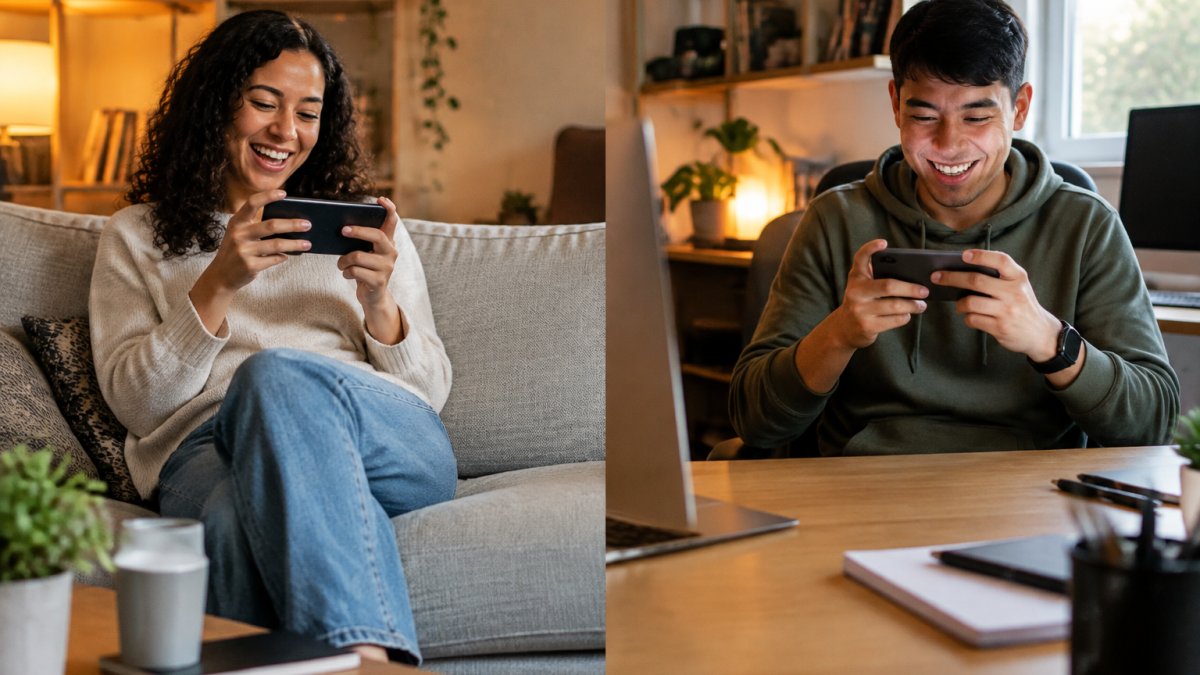
A practical routine for remote friend play:
- Pick a game with no install. Downloads create version mismatches and setup delays.
- Skip the account wall. Accounts add friction and, sometimes, progression advantages.
- Play turn-based or tap-based games if your connections differ in quality.
- Agree on the rules before the first move. Especially rematch rules.
- Keep it free. The moment money enters, so does the incentive to bend things.
If you want a place to actually do this, games with friends lets you send a single link and start playing, no sign-up and no waiting room.
A Step-by-Step Way to Evaluate a Game's Fairness
Most discussions of casual game fairness stop at a feeling. This section turns it into a checklist you can run in about ten minutes. The framework separates fairness into five dimensions, matchmaking, rules, access to content, input methods, and team balance, because a game can pass one and fail another, and a single yes-or-no answer hides that.
Run each dimension as a short set of checks. Score each check 1 for pass, 0 for fail, and keep the dimension scores separate rather than adding them into one number.
Dimension 1: Matchmaking
- Does the game show you why you were matched? A rating, a skill band, or a post-match summary counts. Silence does not.
- Is connection quality part of the pairing? Look for region or ping information. If the game never mentions it, assume it is not.
- Can you choose your opponent? Direct challenges and friend invites sidestep the algorithm entirely, which is the simplest fairness fix available.
Dimension 2: Rules
- Are the rules the same for both players? Asymmetric games can be fair, but only if the asymmetry is visible and intentional.
- Is hidden information part of the design or an accident? Hidden cards are fine. Hidden stats one player can buy or unlock are not.
- Does the server verify moves? If the game cannot tell you, assume it does not.
Dimension 3: Access to Content
- Can a new player reach the same tools as a veteran without paying? Time-gated unlocks are a soft advantage; paid unlocks are a hard one.
- Is there a battle pass or season track that changes match outcomes? Cosmetic tracks are fine. Gameplay-affecting tracks are pay-to-win in slow motion.
- Are there ads that interrupt play or grant advantages for watching? Either one tilts the match toward whoever tolerates more interruption.
Dimension 4: Input Methods
- Does the game treat controller, keyboard, and touchscreen as equivalent? Try a round on a phone and a round on a desktop. If the results swing wildly, the game is not input-neutral.
- Does cross-play separate players by input type? Many competitive games offer input-based matchmaking. Casual games often do not, which is fine for tap-based designs and a problem for precision ones.
- Are accessibility options available without changing the competitive balance? Remappable controls, colorblind modes, and adjustable timing are fairness features, not extras.
Dimension 5: Team Balance
- Can a party of mixed skill be matched fairly? If the game averages the party, a strong player can carry weaker friends. If it matches on the highest rating, the group is punished. Neither is wrong, but the choice should be visible.
- Does the game fill empty slots with strangers or bots? Bots can be fair if labeled. Unlabeled bots are not.
- Is there a rematch option? Rematches reward learning over luck and let a losing player close a skill gap against a specific opponent.
Watch out: a game can pass every check on paper and still feel unfair because it never explains itself.
If you want to run this checklist against a few options side by side, our roundup of casual game alternatives gives you candidates to score. And if you want the wider picture on how players and games are distributed across the casual space, the game statistics page has the numbers.
Here are the five dimensions to score separately, with the checks that matter in each.
| Dimension | Key checks | What to watch for |
|---|---|---|
| Matchmaking | Shows why you were matched; connection quality in pairing; can you choose opponent | Silence about rating or skill band |
| Rules | Same rules for both players; hidden info intentional; server verifies moves | Hidden stats one player can buy or unlock |
| Access to Content | New player can reach same tools without paying; battle pass; ads | Gameplay-affecting tracks are pay-to-win in slow motion |
| Input Methods | Controller, keyboard, touchscreen treated as equivalent; input-based matchmaking; accessibility options | Results swing wildly between phone and desktop |
| Team Balance | Mixed-skill parties matched fairly; bots labeled; rematch option | Unlabeled bots are not fair |
Challenge a Friend to a Fair Match
The fairness question has a simple answer at the small scale: play games where the only variable is you and your friend.
BeatMe Games is built for exactly that. Every game runs from a link you drop into a chat, with no app, no sign-up, and no accounts.
Next time a score needs settling, skip the lobby. Challenge a friend to a fair match and let the result speak for itself.
Frequently Asked Questions
What makes a casual multiplayer game fair?
A fair casual multiplayer game gives both players the same rules, the same information, and the same chance to win before the first move. That means no hidden stat advantages, no paid upgrades, and no way for one side to see the other's choices early. Server-side move verification adds another layer: the game checks every move on the server rather than trusting the player's device, so results can't be edited after the fact. When those conditions hold, the better player on the day wins, and the loser knows exactly why.
Why can casual multiplayer games feel unfair even when they aren't rigged?
Most unfairness complaints come from mismatch, not cheating. If an experienced player meets a first-timer, the scoreline looks lopsided and the newcomer assumes the game is broken. Randomness plays a part too: a couple of unlucky rounds can feel like the game is against you. Matchmaking fairness is judged on feelings as much as numbers, which is why short, repeatable matches help. Playing several quick rounds lets skill show through instead of one bad result defining the experience.
Do free browser multiplayer games need accounts to prevent cheating?
No. Accounts are one way to deter cheating, but they are not the only one and they add friction that casual players rarely want. Server-side move verification does the real work: the server holds the game state, validates each move, and rejects anything that breaks the rules, so a modified browser or a tampered client cannot change the outcome. That approach keeps games instant to join while still protecting the result. Requiring a sign-up mostly stops casual players from playing at all.
How can two friends make a match more balanced when their skill levels differ?
Pick games where the rules are symmetrical and rounds are short, so luck and learning even out over several attempts. Play best-of-five rather than a single round, swap sides or starting positions between rounds, and agree on a handicap if one player is clearly stronger, such as giving the newer player the first move. Keep the stakes social rather than competitive. The goal is a close, funny contest, not a demonstration of who is better at everything.
